


Integrated Educational Strategic
Planning Process 2025-26
Purpose
Los Medanos College’s Educational Strategic Plan 2026-2031 is a forward-looking, student-centered roadmap that guides the College’s collective efforts over the next five years. Grounded in our Mission, Vision, and Values, the plan affirms our commitment to equitable student success, meaningful community impact, and continuous institutional learning.
Higher education continues to evolve in response to advances in technology, shifts in workforce needs, and the growing diversity of the communities we serve. These changes present not only challenges, but also powerful opportunities. At Los Medanos College, we view this moment as one of possibility—an opportunity to strengthen what we do best while reimagining how we serve students and our community with greater intention, equity, and effectiveness.
This Educational Strategic Plan serves several essential purposes:
- Clarifying Direction: Defining shared priorities that align our daily work—across instruction, student services, and operations—toward common goals.
- Advancing Equity: Centering the outcomes, metrics, and processes of the Student Equity Plan, ensuring that closing equity gaps and supporting disproportionately impacted students remain at the heart of institutional decision-making.
- Strengthening Integration: Centering program review, resource allocation, student learning outcomes assessment, and other institutional plans into a coherent, cyclical planning process.
- Fostering Collective Ownership: Reflecting the voices of students, employees, and community members, reinforcing the idea that strategic planning is not a simple document, but rather a meaningful, ongoing, and shared practice.
Ultimately, this plan is both a guide and a commitment: a guide for how we will prioritize our efforts, and a commitment to ensuring that all students have the opportunity to thrive, complete their goals, and contribute meaningfully to our community.
Process
The Educational Strategic Plan was developed through a comprehensive, participatory, and iterative process grounded in two core principles:
1. An Equity-Centered Planning Process Centering Student Equity
The process is anchored in the College’s Student Equity Plan — its outcomes, metrics, and prioritized student populations. Equity is embedded throughout the planning process, shaping how priorities are identified, goals are developed, and success is measured.
2. A Continual Integrated Planning Cycle
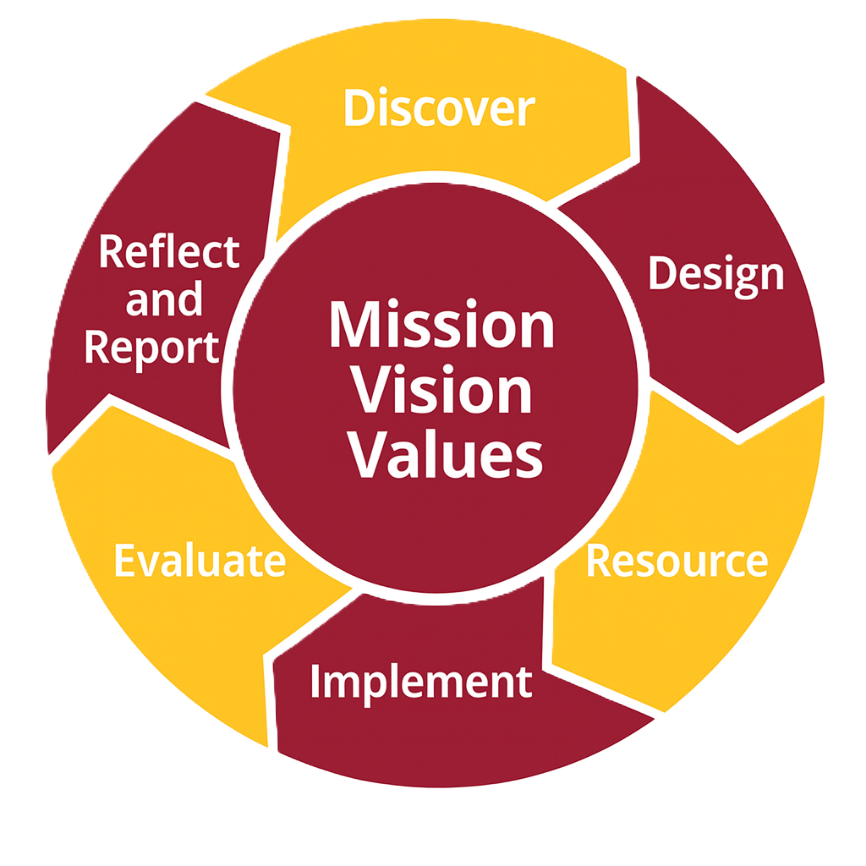
All planning efforts at Los Medanos College are guided by the cycle:
Discover → Design → Resource → Implement → Evaluate → Reflect & Report
This cycle is centered on the College’s Mission, Vision, and Values, ensuring that planning is continuous, evidence-based, and responsive.
Development Process
Discover Phase (Spring - Fall 2025)
The Discover phase focused on building a shared foundation through data, engagement, and equity-centered inquiry.
- Mission, Vision, and Values Development (Spring – Fall 2025)
College-wide engagement informed updated Mission, Vision, and Values, establishing the foundation for all planning. - Identification of Prioritized Student Populations (Spring – Summer 2025)
Institutional and Student Equity Plan data identified disproportionately impacted student populations. - Launch of Integrated Planning (September 2025 College Assembly)
The College aligned Program Review, the Student Equity Plan, and the Educational Strategic Plan within a shared cycle. - Community Forums (October 2025)
Community members contributed input on access, programs, learning outcomes, and partnerships. - Student Equity Plan Development and Submission (Fall 2025)
The Student Equity Plan was finalized and submitted, providing core metrics and priorities.
(Reference: Student Equity Plan webpage) - Data and Metrics Review (October 2025 College Assembly)
Institutional and equity data were analyzed to inform goal development.
Design Phase (Fall 2025 - Spring 2026)
The Design phase translated discovery into structured priorities, goals, and measurable outcomes.
- College-Wide Engagement and Goal Area Survey (Fall 2025)
Surveys and MentiMeter activities across all constituencies identified shared priorities. - Development of Draft Goal Areas (November 2025 College Assembly)
Draft goal areas were refined through collaborative activities and dialogue. - Drafting Objectives and Measures (December 2025 – January 2026)
The Planning Committee and Shared Governance Council developed objectives and aligned metrics grounded in institutional and equity data. - Refinement and Selection of Goal Language (February 2026 College Assembly)
Eight draft areas were consolidated into four integrated goal areas:- Campus Culture
- Equitable Student Access, Learning, and Outcomes
- Partnerships
- Continuous Improvement
- Constituent Feedback on Goal Language (March 2026)
Shared Governance Council representatives gathered structured feedback from all constituency groups
Integration with Program Review (Spring 2026)
A defining feature of this process was the integration of program-level planning.
- Program Review Submission (February 27, 2026)
All departments submitted Program Review documents aligned to equity priorities and institutional goals. - Thematic Alignment and Integration (March 2026)
Program Review activities were:- Thematically grouped
- Mapped to strategic goals and objectives
- Synthesized into broader institutional strategies
This step ensured that the Educational Strategic Plan reflects:
- Real departmental work
- Cross-functional priorities
- Scalable, college-wide initiatives
Governance Review and Plan Finalization (Spring – Summer 2026)
The Educational Strategic Plan progressed through participatory governance and approval processes.
- April – May 2026:
A cross-constituent subgroup of the Shared Governance Council collected feedback from their respective groups and utilized this together with student senate feedback to refine the language of the strategic plan goals. The new language was approved by SGC on April 8, 2026. - At the April 13th Academic and Classified Senate meetings, senators were provided with access to the full-text of the plan and encouraged to read at least the Executive Summary and Goals, Objectives and Activities sections in preparation for the 1st read of the document on April 27th. The Final complete text of the Educational Strategic Plan is available for District employees only.
- Shared across constituencies, the Plan continued to improve through feedback and revision and was approved by Academic, Classified and Student Senates along with the Los Medanos College Shared Governance Council in May 2026.