Shared Governance Council (SGC) Position Paper

At Los Medanos College, we commit to participatory governance and active representative leadership, as evidenced by the membership and work of the Shared Governance Council (SGC).  Our College community emphasizes being inclusive, listening actively, and making sure people feel seen, heard, and valued in processes designed to lead to effective decisions that center students. A key goal of our participatory governance model is to ensure that different voices, backgrounds, and perspectives are reflected in how we plan, work together, and accomplish our goals. 

The long history of participation by all of the College constituencies is a foundational characteristic of Los Medanos College, its participatory governance model, and SGC. In order to address college-wide issues, challenges, and future opportunities, SGC engages in collaborative decision-making and utilizes bi-directional communication efforts.


  • Purpose & Vision

    The long history of participation by all of the college constituencies is a foundational characteristic of Los Medanos College (LMC) and this shared governance model.  LMC’s participatory governance history, our immediate challenges and our future opportunities require us to engage in effective and collaborative governance.  This Shared Governance Model gives the College a structure for creating its vision with the guiding question:  what does this issue, decision (etc.) mean for us as an institution?

    Shared governance - in its broadest sense, a participation of and mutual deliberation by the College Senates, the President, and the management team - must be mindful of and defer to the particular legal rights and responsibilities granted to the Governing Board, Chancellor, President, Academic Senate, Classified Senate, Student Senate, and collective bargaining units.  It is very important to note that neither the rights (primarily rely or mutually consent) nor the responsibilities of the Academic Senate in academic and professional matters noted in legislation and law are abridged, challenged or limited by this model.  Similarly, the obligations and rights of the President, Classified Senate, Student Senate, and Management Team remain unchallenged.

    This model aspires to continually move us toward forward-looking decision-making, with an  emphasis on equitable outcomes and processes.  The model assumes that plans and resource allocations affecting the institution as a whole will be reviewed and approved (if necessary) by the representative Shared Governance Council, thus benefitting from a focus on collective interests and from the coalescing of diverse perspectives contributed by all constituency groups .  Presidential participation in the Shared Governance Council and evaluation are noted as key elements of this model. 

    Los Medanos College’s evidence-based planning efforts – in particular, its Educational Master Plan (Master Plan) and Strategic Plan – should be the driving force for key decisions.  The College’s governance must be inextricably tied to the important issues and the professional thinking imbedded in these plans, which will guide the Council members in all facets of their work.  

    The governance model that follows should provide: support for the achievement of the College Mission; development and oversight of College policies; and codification of College processes. 

    The Shared Governance Council focuses on high-level issues addressing the Mission of the College that may include, but are not limited to: future regional needs, new program commitments and initiatives, existing program contractions, program eliminations, and financial planning.  

    The following flow chart illustrates the relationship of the Shared Governance Council, Senates, Management Team, and President in relation to the movement of recommendations through SGC. 
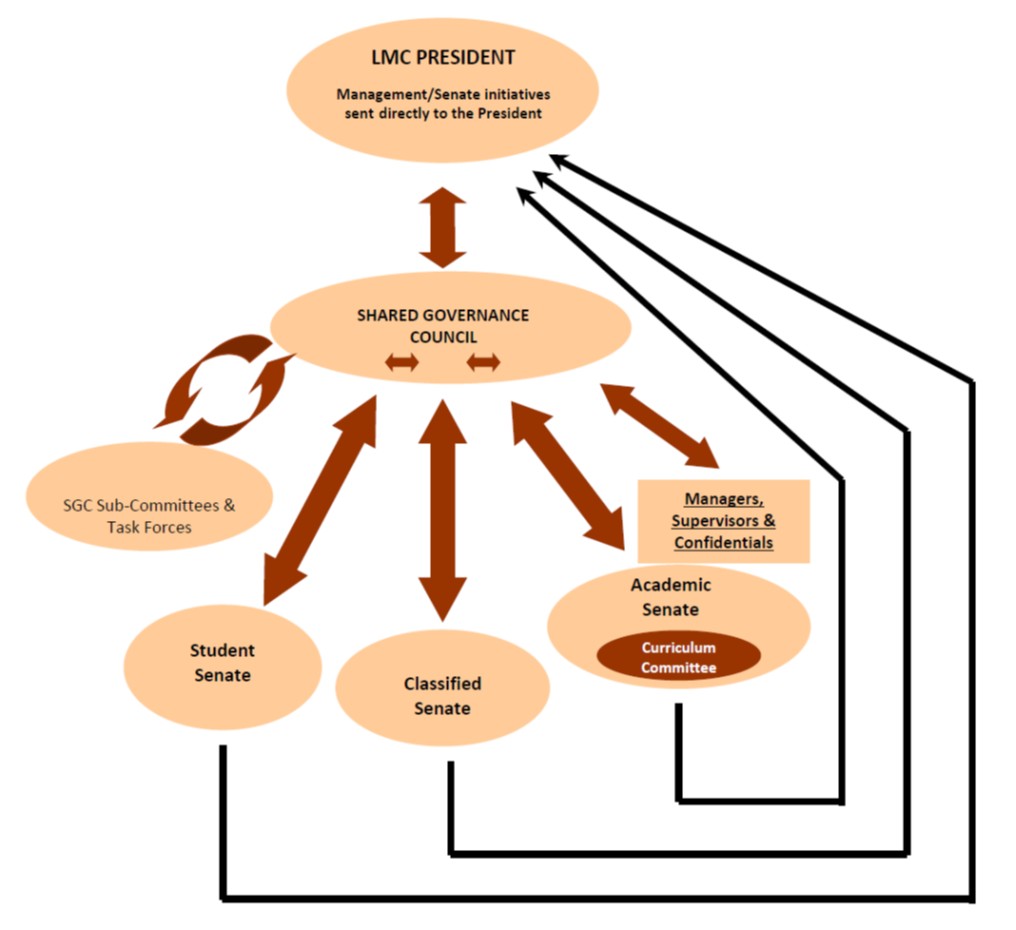
     

    Diagram showing flow of recommendations through LMC's participatory governance model


  • Senates, Managers & Shared Governance

    Formally noting the relationship among the Senates, Management Team, and the Shared Governance Council is a key element of participatory governance at Los Medanos College.  The success of this shared governance model is predicated on the nexus of informed and effective Senates and a collaborative management philosophy.  Responsible and ethical representation is critical.  

    The Senates, in partnership with the President, act as a check and balance for the Shared Governance Council.  The Senates choose their representatives on the Shared Governance Council.  The President selects the management representatives.  This model acknowledges that the Shared Governance Council cannot abrogate the Academic Senate’s rights in academic and professional matters; but it may offer recommendations or comments on particular issues of importance.  It is understood that the Student Senate, Classified Senate, Academic Senate, and Management Team may bring recommendations directly to the President.  The Shared Governance Council maintains the right to send an accompanying recommendation or comment.

    While any constituency or group can initiate and recommend policy or program changes, the Council normally reviews all such proposals.  A distinction is made among Senate recommendations, Presidential recommendations, and recommendations from shared governance committees covered by this model.  Senate recommendations are discussed and reviewed by the Shared Governance Council.  The Council may express their own concerns about Senate proposals in writing, both to the other Senates and to the College President, if the members feel implementation of the proposal would adversely affect other constituency groups or operations.

    The Council forwards the recommendations from any Senate to the voting members of the other groups for the purpose of generating input and facilitating discussion.  This is done in an attempt to ensure a wide array of input and to identify potential conflicts before formal presidential approval.

  • Shared Governance Council
    Role

    The Shared Governance Council is charged with promoting and facilitating collaborative decision-making at LMC.  It devotes itself to the College’s most significant issues and challenges.  The role of this Council is to focus on broad, high-level policy concerns.

    The Council is a key body in the approval of strategic goals as an expression of the Master Plan and Strategic Plan.  First, the Council will lead the implementation and evaluation of the annual planning cycle and resource allocation by: directing the activities of all Shared Governance Committees; and reviewing all new policies and allocation processes proposed by the Shared Governance Committees, the Senates, and the College President.  Planning, and policy making linked to planning, should be the major focus of shared governance and its organizational components.  

    SGC serves as the College’s budget committee and oversees the College’s annual Resource Allocation Process (RAP).  As part of RAP, the Council reviews the proposals submitted for Program Improvement and Permanent Classified Staffing and then makes funding recommendations to the President.  Throughout the year, SGC also receives updates on the budget and budget development process.

    The Shared Governance Council works with policy in a multi-faceted way including its creation, incremental development, maintenance, and periodic evaluation/review.  While policy initiation and recommendation can occur within numerous constituencies at the College, the Council is the most appropriate and formal step in final policy review and recommendation to the President.  The Shared Governance Council is a collective review forum where representative leaders validate the support and integrity of recommendations. 

    The Shared Governance Council is a coordinating group for multiple and diverse efforts (new and old) that occur college-wide and within the various departments and programs of the institution.  The Council assists with the synthesis of deliberation and planning across operational units of the College to whatever degree required.    Operation units and the management team remain the primary implementers of College policy and agreed upon unit initiatives.

    The Shared Governance Council is the locus and coordinator of college-wide communications.  The Shared Governance Council facilitates bi-directional communication among the various constituency, particularly between and among the Senates, regarding policy matters of importance to the entire College community.  As reliable and accessible written communications are key to institutional coherence and employee morale, the Council will promulgate recommendations of college-wide importance.  These communications can take many forms, but they should be constant, consistent and pervasive.  SGC develops the “Monday Meeting Calendar,” which includes multiple College Assembly sessions each semester.  These all-college Assembly meetings consist of program/institutional/district information and updates and create opportunities for broad discussion and input.  Reliable and accessible written communications are a key to governance success and should include clear information on timelines and processes.

    Additional activities that befit the energy and attention of the Shared Governance Council are assisting the President in assessing unforeseen or quickly developing opportunities for and threats to the College, and developing intervention strategies to address these.  The Shared Governance Council also coordinates sub-committees and ad hoc task forces.  (See COMMITTEES and TASK FORCES.)


    Membership

    The Council shall have three voting members from each major constituency (Classified Senate, Academic Senate, Student Senate, and Management Team).  These voting members will be elected and ratified by their respective groups, for terms to be determined by each (but no less than one year).  The representative members are selected by the criteria chosen by the respective constituency.   The Senates will annually give the President the names of their appointed members, preferably in the Spring semester in anticipation of the next academic year.  The President will select the management representatives and, in turn, notify the Senates.

    COUNCIL MEMBERS: The Council has twelve voting members, with equal representation from each constituency group.  The President (or the designee) will be the chair and meeting facilitator of the Council.

    To facilitate Council deliberations various “experts” from within and outside the College community are called in to attend meetings and provide input and insight.  Such experts may, for example, include governance committee chairs or program/department leads.  These experts do not have voting rights on the Council, but are key to informed discussion and decision-making.


    Meetings

    The Council meets regularly, generally twice each month during the academic year.  SGC holds open meetings and adheres to the provisions of the Brown Act.  


    Voting

    The Shared Governance Council has twelve voting members, with equal representation from each constituency group.  When voting is necessary, the members of a constituency in attendance can cast all of the votes for that constituency (e.g. the three Classified votes can be cast by the one and only representative in attendance on any given day).  The attending representative(s) may cast a total of three votes whether one, two, or three representatives are in attendance.  Votes are recorded by the name of the voter/Shared Governance Council member – including those cast in absentia by another Council member.  In the event of a tie, the SGC chair will be allowed to cast a vote on a motion.

    The Council votes on all recommendations from shared governance committees, and takes advisory votes on Senate recommendations.  The advisory votes are on whether to forward additional commentary to the President on the Senate recommendations.  As noted above, the Council may not vote down any Senate recommendation, as these are automatically forwarded to the College President.


    President on the Council

    The President serves as the chair and meeting facilitator.  However, the President may delegate the role of meeting facilitator to promote her/his unencumbered and active meeting participation.  The President does not vote at meetings, but participates freely in the deliberations.  The President receives recommendations from the Shared Governance Council.

    Presidential proposals for institutional action are first offered to the Shared Governance Council for review.  This may be an informal notice.  This model acknowledges that the pre-notification of the Council regarding decision-making is best, but notes that emergency decisions are warranted in some circumstances.  In these cases, a post-decision briefing is warranted.  The President also communicates with the entire College, as needed.  

    The President should also evaluate the Shared Governance Council’s effectiveness on a regular basis, including a review of its processes and outcomes and actively work with the Shared Governance Council to set goals, review outcomes, and archive the agreements, policies, and decisions that emanate from the Council.

  • Committees & Task Forces

    The Shared Governance Council authorizes the creation and the charges of Shared Governance committees and Shared Governance task forces needed to complete the Council’s work on an annual basis.  Committees and task forces created by position paper or other shared governance bodies must be reauthorized and charged by the Shared Governance Council.  (Excluded are subsets of the Senates and operational team meetings).

    As part of the annual authorization process for Shared Governance task forces or Shared Governance committees, the Council maintains a list of authorized committees, their charge(s) and function(s), planned outcomes, and duration of authorization (sunset dates).  The charges are accompanied by proposed evaluation criteria.  All work completed by the Council’s authorized committees and task forces and their recommendations are submitted to the Council for evaluation and review.  Governance committee recommendations should/must include projected costs to the College (if applicable), timeframe for implementation, and evaluation criteria that may be used by the Council to determine the effectiveness of the recommendation over time.  Many committee recommendations involve new processes or procedures, and the Council would expect these to be detailed in the recommendation.  One of the first tasks of the Shared Governance Council is to review the recent activities of all existing shared governance committees on campus.  After this review the Council may decide to disband moribund committees, to form new committees, or to consolidate the activities of many separate committees into one.

  • Evaluation

    The Council members undertake an annual written self-evaluation.  This includes a statement of basic College goals and major initiatives the Council intends to promote and discuss during the coming academic year, and then, at the end of the year, a brief summary of all major recommendations reviewed (and all votes taken) during that year.  The Council makes its self-evaluation reports available to the Senates and to the Management Team for external review.  

    As part of the College’s commitment to continuous improvement, the Shared Governance Council and this model are subject to self-evaluation and planned external critique, which include identification and analysis of accomplishments and missed opportunities.

  • Summary

    The Shared Governance Council is a forum where all constituency groups are at the table for College dialogue and decision-making.  It presents a collaborative, bi-directional relationship wherein the Senates and Management Team talk directly to each other, with the President participating in and listening to discourse.  SGC provides for constituency-based input on major issues and discussions, and is a central place where synthesis can occur.